


Corfu Town Hall – Analytical Guide

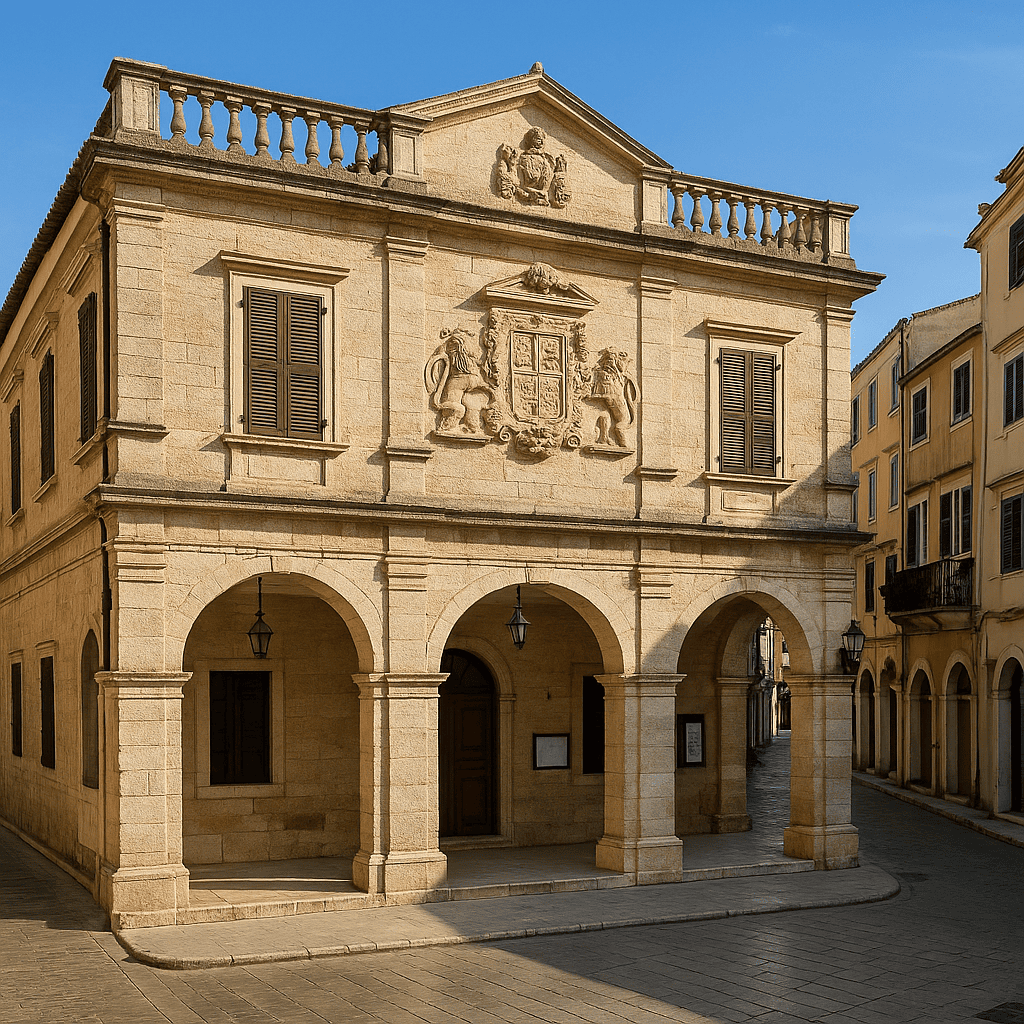
Tucked within the heart of Corfu’s historic old town, the Corfu Town Hall, also known as the San Giacomo Building, is one of the most emblematic architectural landmarks on the island. It stands not only as the center of administrative activity for Corfu Town but also as a historical symbol of Venetian elegance and urban continuity.
This analytical guide explores its history, architecture, function, and cultural relevance, offering a deep look into one of Corfu’s most treasured civic monuments.
🏛️ Historical Background
The building that today functions as the Corfu Town Hall began its life in 1693 during the Venetian rule, not as an administrative center, but as a Noblemen’s Club (Loggia dei Nobili). It served as a gathering place for the island’s aristocracy — a space where Venetian noblemen could meet, socialize, and engage in political and cultural discourse.
Later, in the 18th century, the building was repurposed as the San Giacomo Theatre — the first modern-style theater in Greece. It hosted operas and performances that reflected the strong Italian cultural influence of the time. The theater remained active until the late 19th century, when it was finally transformed into the municipal building it is today.
The structure’s long-standing presence reflects Corfu’s continuity of civic life, transitioning from aristocratic leisure to cultural refinement, and finally to modern governance.
Architectural Analysis
The Corfu Town Hall is a rare example of Venetian Baroque architecture in Greece, with distinct Renaissance and early neoclassical elements. Built entirely from local stone, the building impresses with its proportion, symmetry, and refined detailing.
Key features include:
Arched ground-floor colonnade – a characteristic of Venetian civic architecture
Rectangular upper-floor windows with classical moldings
A finely sculpted frieze with coats of arms and Latin inscriptions
A modest pediment, blending classical proportions with local Ionian aesthetics
Unlike other imposing public buildings of the era, the Corfu Town Hall maintains an intimate human scale, reflecting the balance between formality and approachability.
The façade has been carefully preserved, with several original sculptural elements still intact — including a stone lion of Saint Mark, a symbol of Venice’s dominion.
Function and Civic Role Today
Since the late 19th century, the San Giacomo building has operated as the seat of the Corfu Municipality. It houses the Mayor’s office, city council meeting rooms, and various municipal departments.
Beyond its administrative functions, the Town Hall also serves as a public venue for:
Official ceremonies and receptions
Cultural events and exhibitions
Local community meetings
Its position in the center of the pedestrian old town reinforces its role as the symbolic and functional heart of local democracy.
A Theatre’s Ghost – Cultural Heritage and Memory
Although the building no longer hosts theatrical performances, the legacy of the San Giacomo Theatre lives on in Corfu’s cultural memory. It was here that the island’s elite — and later the general public — were introduced to Italian opera and dramatic performance.
Corfu’s strong connection to philharmonic music and choral traditions can be traced back to the artistic culture nurtured within the walls of this building.
For cultural historians and architects alike, the Corfu Town Hall is an essential case study of how a structure can morph through time while retaining its historic soul.
Location and Urban Integration
The Town Hall is located on Evlampidou Street, near the central square of Corfu Town and just a short walk from the Liston promenade. Its proximity to the Church of Saint Spyridon, the Old Fortress, and the Spianada Square enhances its accessibility and significance.
It is not isolated as an official complex but integrated into the social fabric of daily life. Locals pass by on their errands; tourists admire its façade while wandering the cobblestone alleys.
This integration of history and functionality is what makes the Corfu Town Hall a living monument, not a frozen relic.
Symbolic Importance
The Corfu Town Hall represents more than a place of local governance:
It embodies Corfu’s European character, shaped by centuries of cultural blending.
It reflects a tradition of civic engagement, from aristocracy to modern democracy.
It symbolizes the continuity of urban life, where buildings adapt while their essence remains.
In this sense, the Town Hall is a time capsule that narrates Corfu’s evolution — political, cultural, and architectural.
Conclusion
The Corfu Town Hall is a building of remarkable historical depth and civic symbolism. From a noblemen’s club and opera house to the vibrant administrative center it is today, it has played a central role in shaping Corfu’s identity. It is a must-visit landmark for anyone interested in the layered history of the Ionian Islands.
Its preservation is not just a matter of heritage, but a celebration of public space, local pride, and the blending of cultures that make Corfu so unique.